Complete a marketplace-style order flow without creating a real purchase or shipment.
Fake online shopping simulator
Fake online shopping simulator with virtual carts and no real payment
DreamCheckout is a fake online shopping simulator for browsing products, building carts, completing simulated checkout, cooling shopping impulses, and enjoying ecommerce without real spending.
Use virtual balance and simulator language instead of real payment card details.
Enjoy the shopping ritual while slowing the jump from desire to real spending.
A realistic shopping loop without the real-world bill
DreamCheckout gives you the familiar ecommerce sequence: search, product pages, ratings, carts, checkout, order tracking, and reviews. The difference is that the flow is simulated, so no real product is sold or shipped.
Made for impulse cooling, play, and ecommerce testing
Use it as a safe browsing ritual when you want the feeling of shopping, as a delay tool before buying for real, or as a sandbox for studying product pages, recommendations, cart design, and checkout psychology.
Clear boundary: fake checkout, honest simulator
The experience is designed to feel satisfying, but not confusing. Products, prices, balances, tracking, delivery, and reviews support the simulation unless something is explicitly marked as a real-world transaction.
Complete the familiar cart and order flow without entering a real card or creating a real purchase obligation.
Move the urge into a virtual cart first, then decide later whether the desire still deserves real money.
Keep the fun parts of discovery, comparison, checkout, tracking, and reviews inside a clear simulator boundary.
Repeated fake carts reveal whether you are looking for comfort, control, status, novelty, rest, or a real solution.
Detailed explanation
How a fake checkout can help with real shopping pressure
DreamCheckout is not a store and not therapy. It is a structured simulator that gives the shopping impulse somewhere safer to go before it reaches a real card, a real package, or real regret.
Definition
What is a fake online shopping simulator?
A fake online shopping simulator is a marketplace-like experience where you can browse products, open product pages, compare options, add items to a cart, and complete a checkout flow without creating a real purchase. It looks and feels close to ecommerce because the familiar surface is the point: search, categories, ratings, recommendations, prices, product details, checkout, order tracking, delivery statuses, and reviews all help the brain recognize the shopping ritual.
DreamCheckout is built around that idea, but with the boundary made explicit. The balance is virtual. The checkout is simulated. Product information supports browsing and play. Order tracking is generated by software. No real product is sold or shipped through the simulator. That distinction matters because the page is meant to be satisfying without being deceptive. It should scratch the shopping itch, not trick someone into thinking a package is coming.
The best way to understand the product is as a safe ecommerce rehearsal. You can test the feeling of wanting something, organize that want into a cart, complete the loop, and then ask whether the desire still matters when the hot moment cools. Sometimes the answer is yes: the item may belong on a real budgeted wishlist. Often the answer is no: the desire was a mood, a stress response, a fantasy, or a five-minute need for progress.
Who it is for
Who searches for this kind of simulator?
Some people search for a fake online shopping simulator because they enjoy the look and rhythm of online stores. They like product grids, wishlists, comparison, ratings, and the little spark of finding something that feels perfect. For them, DreamCheckout is entertainment: a place to build dream carts, imagine upgrades, browse categories, and finish a pretend order without spending money.
Other users arrive because real shopping has become too automatic. They know the pattern: stress, boredom, late-night scrolling, add to cart, checkout, dopamine spike, then regret. They may not need a severe intervention; they may simply need a pause surface. A simulator can provide a gentler alternative than a hard no. It says: you can still browse, you can still choose, you can still complete a loop, but you do not have to turn the feeling into a real charge.
There is also a builder audience. Ecommerce designers, developers, marketers, product managers, and founders can use a realistic shopping simulator to examine checkout flows, product pages, cart friction, recommendation rows, abandoned cart emails, review prompts, and account features before connecting real payments or fulfillment. A fake store can teach a lot about real user behavior because the emotional grammar is the same.
Interface proof
How the fake shopping simulator works on screen
DreamCheckout catalog
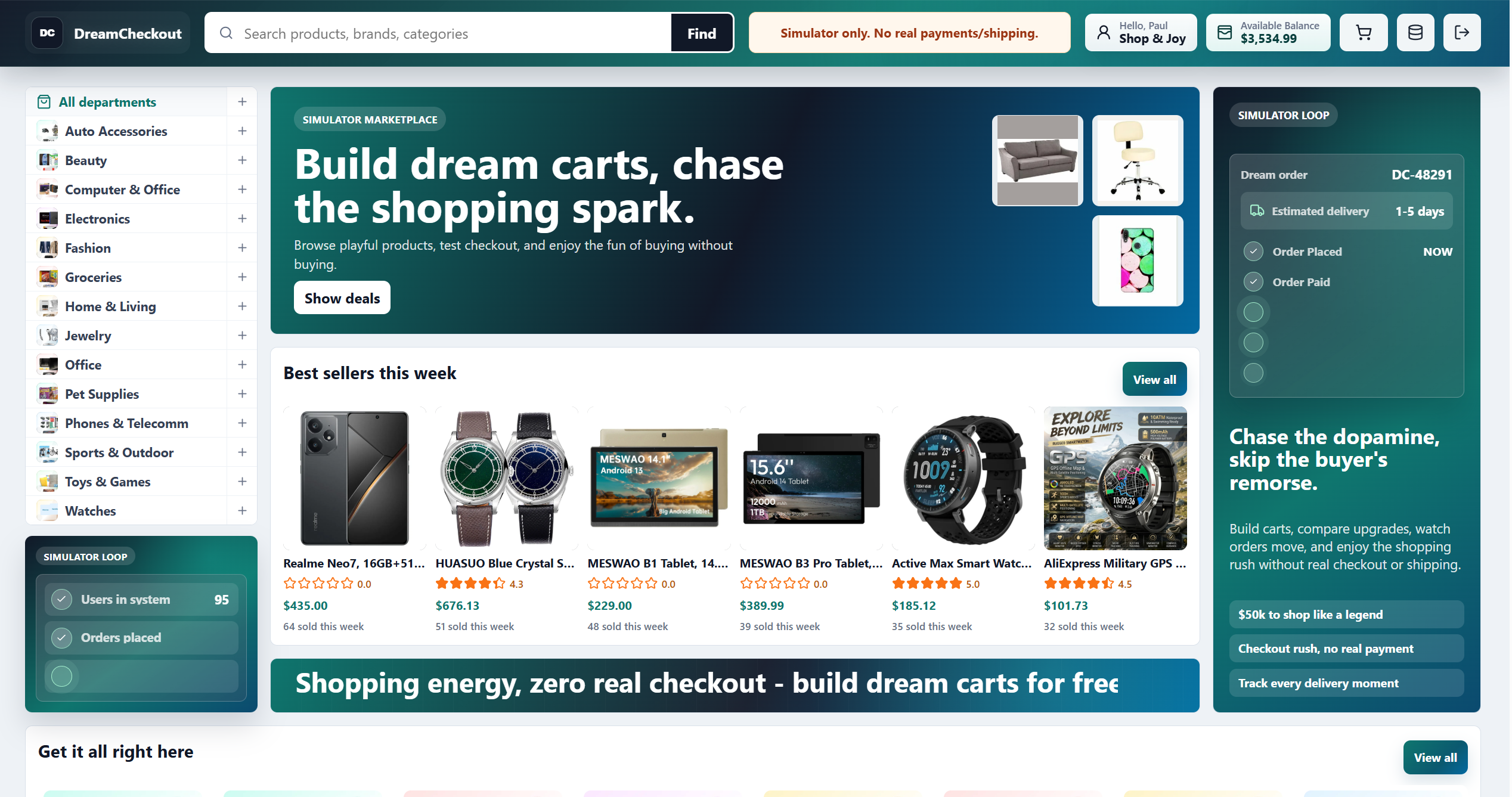
The catalog creates the first layer of a fake online shopping simulator: product discovery, categories, prices, ratings, visual browsing, and a clear simulator-only notice.
Filters and product grid
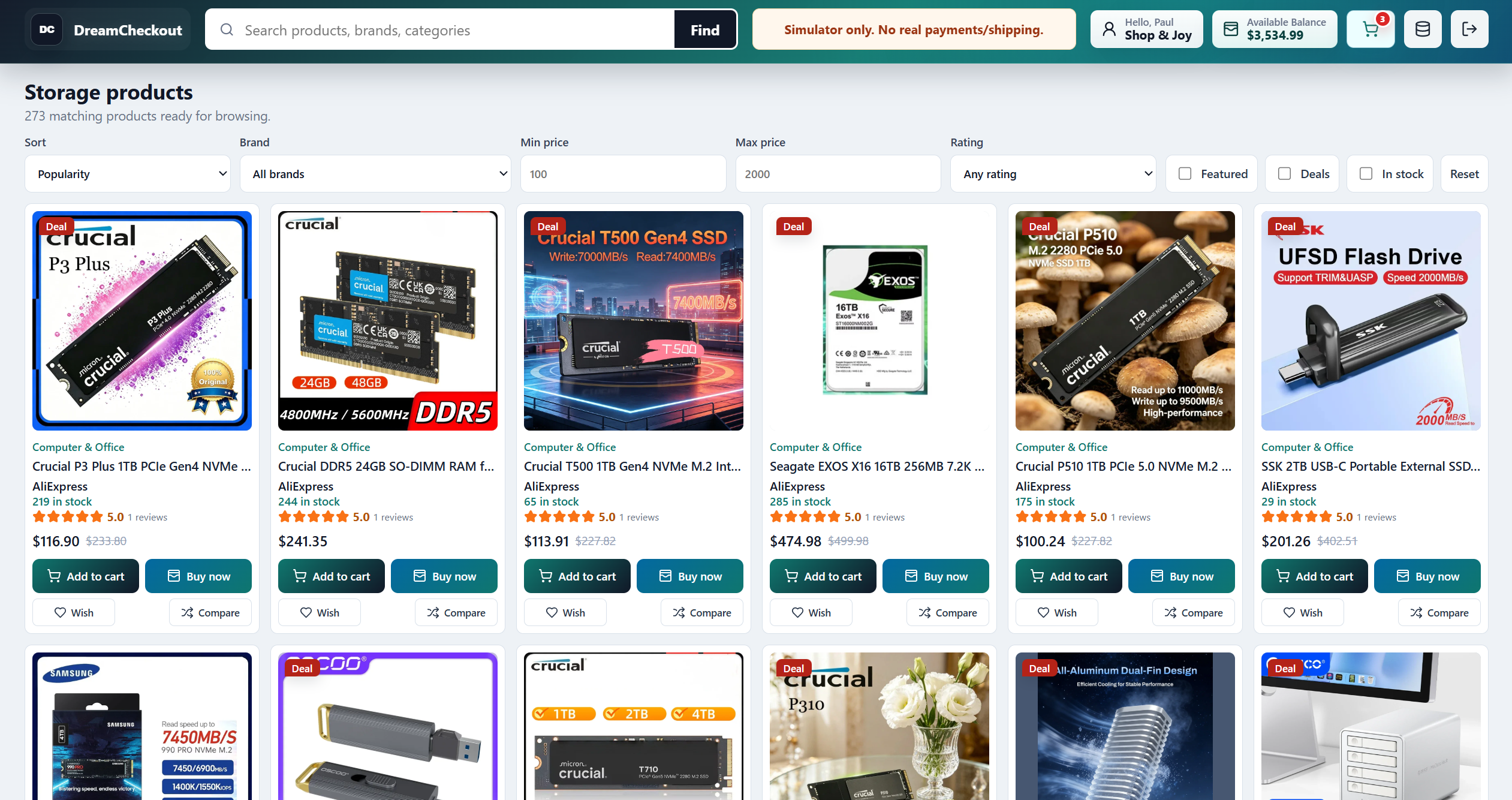
Sorting, brand filters, price ranges, rating filters, deals, stock, wishlist, compare, add-to-cart, and buy-now buttons make the fake store feel like a real ecommerce surface.
Why it helps
The simulator turns an impulse into something visible
An impulse is powerful when it stays vague. "I need this" feels urgent because the mind has not yet translated the feeling into evidence. A cart makes the feeling visible. Which products did you choose? Which category repeated? Which prices felt acceptable? Which brands created excitement? Did the cart look practical, aspirational, comforting, status-driven, or random? Once the urge becomes a list, it becomes easier to inspect.
This is one reason fake checkout can help with real-life shopping pressure. It gives the urge a contained action. Instead of suppressing the impulse completely, you redirect it into browsing, comparing, and completing a simulated order. That can create enough closure for the emotional wave to pass. The point is not to shame wanting things. Wanting is human. The point is to stop treating every want as a command.
The simulator also creates a useful delay. Many buying urges are strongest for a short window. If the product still feels meaningful tomorrow, you have better information. If it feels irrelevant tomorrow, the fake cart saved you from a real mistake. Either result is useful. DreamCheckout turns the moment from "buy now or lose the feeling" into "notice the feeling, finish the pretend loop, and decide later."

Impulse cooling and safe completion
Composite consumer psychologist
A fake shopping simulator is useful when it turns a vague urge into a visible cart, then creates enough closure for the user to pause before spending real money.
Generated composite portrait. This is not a real person or a quoted clinician.- The simulator should create delay, not claim to cure compulsive buying.
- A visible cart helps users inspect emotional patterns before purchase.
- The healthiest session has a clear beginning, fake checkout boundary, and exit.
Dopamine
Why online shopping feels so satisfying before anything arrives
The pleasure of online shopping often comes from anticipation. A product card is a tiny promise: this could make life cleaner, sharper, calmer, richer, easier, more beautiful, or more under control. Search results create possibility. Filters create progress. Product details create justification. Reviews create social proof. The cart creates commitment. Checkout creates closure. That sequence can feel good long before ownership begins.
A dopamine-friendly simulator uses that sequence without hiding the boundary. DreamCheckout lets the user experience novelty, choice, progress, and completion while repeating the truth: this is virtual shopping, not a real sale. The goal is not to remove the pleasure. The goal is to keep the pleasure from automatically becoming a payment, a parcel, a return, or a regret.
This is especially useful for people who use shopping as a stress reset. A stressful day often creates a craving for a small, controllable win. Checkout feels like a win because it is clean, decisive, and immediate. DreamCheckout gives that feeling a safer place to land. The fake order can provide a sense of completion, while the real wallet stays untouched.
Interface proof
Cart, checkout, and account evidence
Cart and checkout path
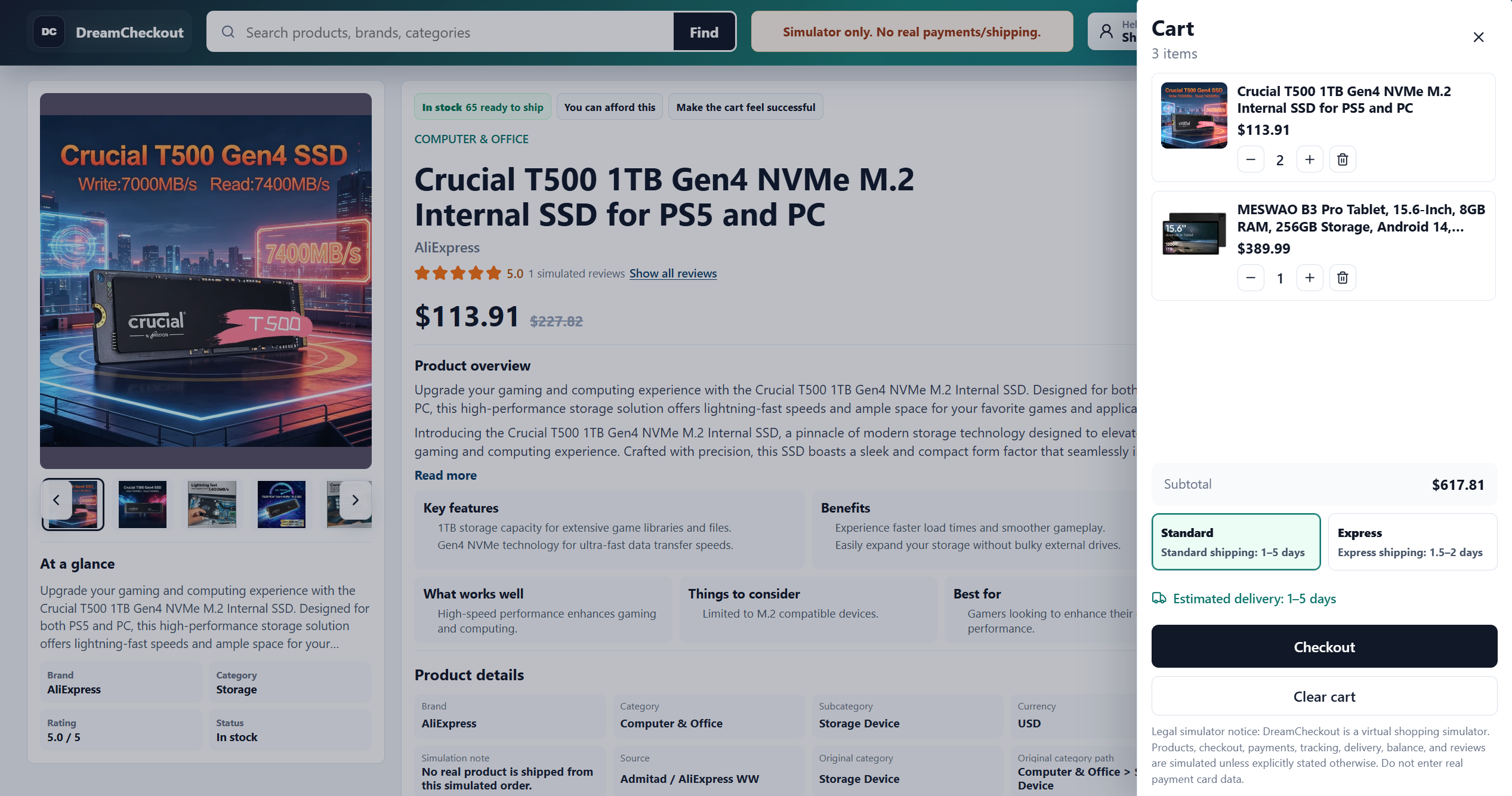
The cart drawer turns browsing into a visible list, shows subtotal and shipping choices, and gives the user checkout-shaped closure without a real payment card.
Account and virtual balance
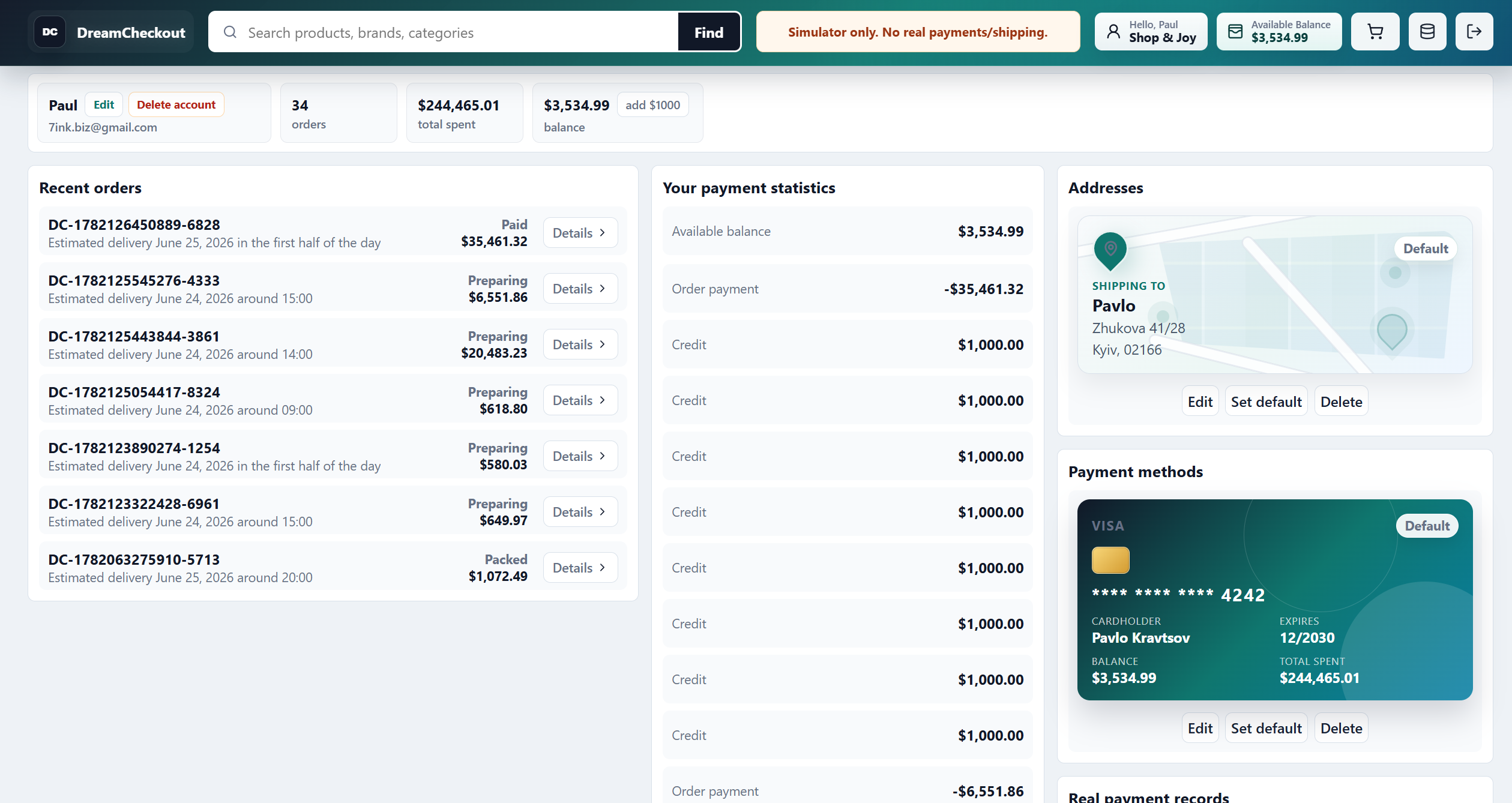
The account area makes the simulator feel complete: recent orders, payment statistics, virtual balance, saved address, and a fake payment method remain inside the no-real-transaction frame.
How to use it
A practical routine for shopping without buying
Start by naming the mood. Are you bored, tired, anxious, ambitious, restless, inspired, lonely, or trying to feel upgraded? Then browse with that mood in mind. This small step changes the session from autopilot to observation. You are still allowed to enjoy the catalog, but now you are watching what the catalog reveals.
Next, build a cart with a limit. Pick three to seven items that match the feeling. Do not try to optimize forever. Add them, compare them, and ask what story the cart tells. A desk setup may be about control. Pajamas may be about rest. Shoes may be about momentum. A luxury watch may be about status or adulthood. A grocery item may be about comfort. The products are clues.
Then complete the simulated checkout if you want closure. Watch the fake order move through the familiar ecommerce story. Afterward, wait. If the desire survives 24 hours, move it into a real decision process: budget, compare, verify, and decide intentionally. If it disappears, leave it in the simulator as a completed fantasy. That is not a failed purchase. That is a successful pause.
Boundaries
What DreamCheckout does not promise
DreamCheckout is not a store, a retailer, a seller, a payment processor for real goods, or a delivery company. Product descriptions, prices, stock messages, ratings, recommendations, reviews, emails, and tracking states exist for simulation, entertainment, testing, and reflection. They should not be treated as retail offers, shipping promises, warranties, medical advice, financial advice, or proof that a real order exists.
The simulator may help some people create a pause between desire and spending, but it is not therapy and it is not a cure for compulsive shopping. If shopping causes debt, secrecy, distress, relationship conflict, or a loss of control, professional support matters. DreamCheckout can be one small tool in a broader pattern of healthier habits, but it should not be asked to do the work of clinical care.
The honest boundary is what makes the playful part safe. A fake checkout is useful only when everyone understands that it is fake. The design should feel rich enough to satisfy the shopping ritual, but clear enough that no user mistakes a simulated order for a real shipment.
Interface proof
Cart, checkout, and account evidence
Tracking interface
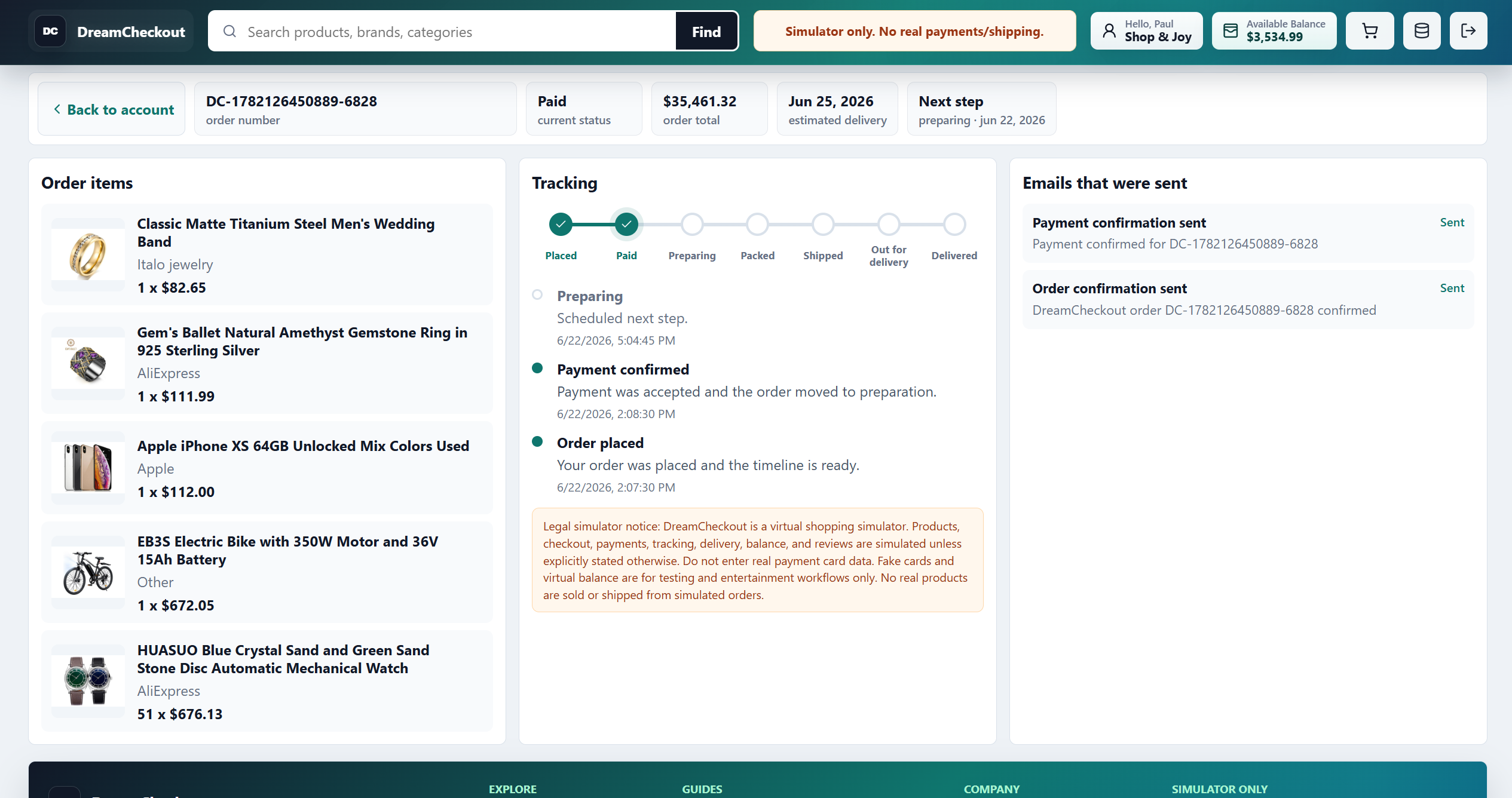
The tracking interface completes the simulated order story with item lists, status steps, email events, and an explicit legal simulator notice.
Order confirmation email
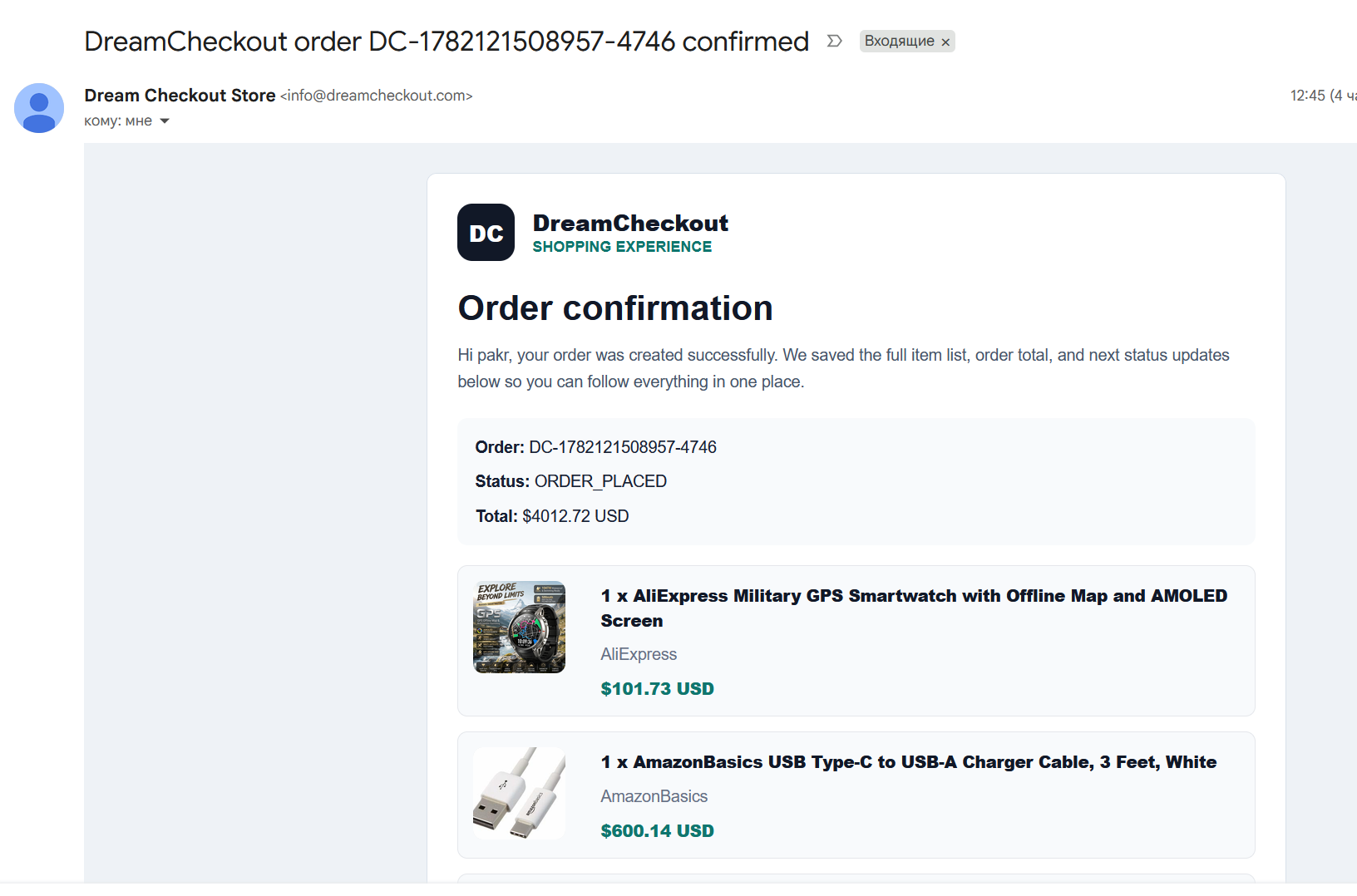
The order confirmation email extends the fake shopping loop beyond the browser with a receipt-like structure, item cards, order status, and branded simulator identity.
SEO intent
Why this is different from a shopping game, wishlist, or scam store
People searching for "shopping simulator" may mean several things. Some want a game where they run a supermarket or mall. Some want augmented reality try-on. Some want a fake checkout page for testing ecommerce. Some want to browse without spending money. DreamCheckout belongs mostly to the last group: it is a shopping-like simulator for virtual carts, fake checkout, impulse cooling, and playful product discovery.
It is also different from a simple wishlist. A wishlist saves desire, but it often leaves the loop unfinished. DreamCheckout gives the whole arc: browse, cart, checkout, tracking, delivered state, review, and recommendations. That full loop matters because closure is part of what people seek from shopping. The simulator supplies closure without real fulfillment.
And it is the opposite of a fake shop scam. Scam stores pretend to sell real products and collect money dishonestly. DreamCheckout openly says that products and checkout are simulated. The purpose is not to trick the user. The purpose is to make the boundary clear while still giving the familiar shape of ecommerce.

Ecommerce realism without fulfillment
Composite retail behavior strategist
The strongest fake store is not the one that tricks users. It is the one that feels familiar while repeating that checkout, payment, delivery, and reviews are simulated.
Generated composite portrait. This is not a real person or a quoted retail executive.- Catalog density, filters, ratings, cart states, and shipping choices create realism.
- Realism must be paired with visible simulator labels.
- DreamCheckout can act as both consumer ritual and ecommerce UX sandbox.
Real life
How a fake shopping flow can improve real buying decisions
A good simulator should not make real purchases impossible. It should make them rarer, slower, and better. If a product is genuinely useful, the fake cart can become the first draft of a real plan. You can compare alternatives, wait for the excitement to cool, check whether the item solves a repeated problem, and decide whether it belongs in a real budget.
This is healthier than pretending desire does not exist. Desire often points at something real: rest, beauty, competence, convenience, confidence, play, comfort, escape, preparedness, or identity. The problem is not the signal. The problem is converting every signal into a purchase. DreamCheckout gives the signal a place to appear without forcing a transaction.
Used well, the simulator becomes a mirror. It shows what you reach for when you are stressed, what you imagine when you want a better future, and what categories keep repeating. That information can lead to better real choices: one planned purchase instead of ten impulsive ones, a budget conversation instead of a late-night checkout, or a non-shopping solution to a non-product need.
Interface anatomy
What a complete fake online shopping simulator needs
A convincing fake online shopping simulator needs more than a pretend buy button. The emotional loop starts with discovery, so the catalog must feel broad enough to invite browsing. Product images, categories, prices, ratings, stock labels, and card actions create the first sense that the user is inside a store-like world. DreamCheckout shows this with a dense catalog surface and a simulator-only notice in the interface.
The second layer is control. Filters, sorting, price limits, brand selection, ratings, deals, featured toggles, and in-stock controls make the user feel that the catalog can be shaped. This matters because many shopping urges are really about control. The user may be stressed by a messy day, but a filter panel behaves predictably. It turns a large world into a manageable set of choices.
The third layer is commitment without consequence. The cart drawer is where a vague want becomes a list. Quantity controls, subtotal, item thumbnails, shipping choices, and a checkout button all make the decision feel real enough to satisfy the ritual. The difference is that DreamCheckout keeps the transaction simulated. The user can experience the structure of checkout without submitting real card data.
The fourth layer is closure. A weak simulator stops after fake checkout. A stronger simulator shows order status, item lists, payment state, tracking events, and email history. These features matter because ecommerce does not end at payment. The anticipation after checkout is part of the emotional reward. DreamCheckout reproduces that anticipation as software states rather than real logistics.
The fifth layer is memory. Account history and confirmation emails let the fake order exist after the session. That can be useful for reflection: the user can revisit what they wanted and decide whether the desire faded. It can also be useful for builders testing lifecycle copy, order emails, retention timing, and abandoned-cart logic without a real fulfillment operation.
Expert view
Why psychologists care about the visible cart
A psychologist would focus less on the product and more on the transition from feeling to action. Many impulse purchases begin as a vague internal pressure: I need something, I need relief, I need a reward, I need to feel different. When the user goes straight from that feeling to a real checkout, there is little space for reflection. A fake simulator can insert a middle step.
The cart is the most important middle step because it makes the urge visible. A person may think they want to buy something, but the cart shows what kind of something. Comfort products point one way. Organization products point another. Status products, beauty products, gadgets, snacks, and home upgrades each tell a different story. The cart becomes a small behavioral note.
This does not mean the simulator is therapy. It means the simulator can support awareness. The user can ask: what mood created this cart, what need do these products represent, which items still matter after the initial spark, and what non-shopping action might answer the same need? Those questions are easier when the urge is visible on the screen.
A fake checkout can also provide closure for people who feel mentally stuck on an unfinished desire. The brain likes loops to close. In real ecommerce, that closure often costs money. In DreamCheckout, the loop can close fictionally. That can be enough for some ordinary impulses to lose intensity.
The boundary remains essential. If fake shopping increases distress, secrecy, shame, or urgency, the user should stop. If shopping causes debt, conflict, or loss of control, professional help matters. The honest claim is not that fake checkout solves compulsive buying. The honest claim is that a visible, simulated cart can help some people pause and inspect ordinary urges.
Retail view
Why retail experts care about realism and trust
A retail expert would look at DreamCheckout as a controlled ecommerce rehearsal. The simulator borrows the components that make online stores legible: product cards, search, filters, ratings, price comparisons, cart state, shipping options, account balance, order details, tracking, emails, and reviews. Those parts are familiar because real retailers have spent years teaching users to understand them.
The challenge is that realism can cut both ways. If the interface is too thin, it does not satisfy the shopping ritual. If the interface is too realistic without disclaimers, it can become confusing or deceptive. The best fake online shopping simulator lives in the middle: realistic enough to feel meaningful, explicit enough that no user mistakes the flow for a real purchase.
This is why simulator language has to appear in multiple places. It belongs in the header, cart, tracking page, emails, account history, disclaimer, and product context. A user should not have to hunt for the truth. The truth should travel with the experience: products, checkout, payments, tracking, delivery, balance, and reviews are simulated unless clearly stated otherwise.
From a product strategy perspective, this clarity is not a legal afterthought. It is part of the value proposition. People can relax into the fake shopping loop because they understand the rules. They can enjoy the interface without worrying about surprise charges or real delivery obligations. Trust makes the playful part safer.
For builders, the same realism creates a sandbox. Teams can test catalog quality, product descriptions, cart friction, checkout copy, order emails, delivery-state language, and abandoned-cart reminders before connecting any real payment or fulfillment system. That makes DreamCheckout useful as both a consumer-facing simulator and an ecommerce UX laboratory.

Tracking, emails, and post-checkout memory
Composite ecommerce lifecycle expert
The tracking page and confirmation email matter because they close the loop. In a simulator, closure can happen without payment, shipping, returns, or buyer remorse.
Generated composite portrait. This is not a real person or a quoted product leader.- Order confirmation makes the fake purchase feel complete.
- Tracking turns the decision into a status narrative without a parcel.
- Abandoned-cart reminders can become reflection prompts instead of pressure.
Lifecycle
Why tracking pages and order emails are part of the simulator
Many fake stores stop at the checkout screen. That misses a large part of why ecommerce feels satisfying. The post-checkout phase is full of emotional signals: order placed, payment confirmed, preparing, packed, shipped, out for delivery, delivered. Each status turns the decision into a story. The user has something to watch.
DreamCheckout simulates that post-checkout story. The tracking interface shows order items, status steps, email events, and legal simulator notice. This is important because closure is not only the button press. Closure is the sense that the decision has entered a sequence and is moving toward an ending. In the simulator, the ending is fictional but still structured.
The confirmation email extends the same structure beyond the browser. It gives the fake order a receipt-like memory: order number, status, total, item list, product cards, and sender identity. Real stores use those emails to reassure buyers and keep them engaged. DreamCheckout can use them to complete the experience and later support reflection.
Abandoned-cart emails are another lifecycle feature worth handling carefully. In real retail, they often pressure the user back toward payment. In a fake shopping simulator, the better framing is reflective: your dream cart is still here if you want to review it. That makes the reminder less about urgency and more about noticing what the cart represented.
This lifecycle layer is what separates DreamCheckout from a simple fake checkout demo. The site does not only simulate the moment of buying. It simulates the story around buying, while keeping the entire story inside a no-real-payment boundary.
Use cases
Who benefits from a fake shopping simulator
The first audience is ordinary shoppers who enjoy browsing but do not want every browsing session to become a purchase. They may like product discovery, ratings, filters, wishlists, and cart building. DreamCheckout lets them enjoy those signals without turning curiosity into a charge.
The second audience is people trying to cool impulse purchases. They may still want the shopping action, but they want a pause before money moves. A fake cart gives the impulse somewhere to go. If the desire fades later, the simulator saved money. If the desire remains, the user can make a slower real-world decision.
The third audience is people who use shopping as stress relief. They may not need a strict ban on browsing. They may need a safer version of the ritual. DreamCheckout can become a five-minute reset: browse one category, build one cart, finish one fake loop, and leave.
The fourth audience is builders. Ecommerce designers, developers, marketers, students, and product teams can use a realistic simulator to study the emotional grammar of online retail. They can inspect how product density, button placement, email language, tracking states, and cart design affect the experience.
The fifth audience is content and SEO teams working around shopping-without-spending intent. A fake online shopping simulator sits next to related queries: dopamine shopping site, shopping without spending money, online window shopping, stop impulse buying online, and best shopping simulators. DreamCheckout can link these pages into a cluster that explains the category from several angles.
Risks
What a fake shopping simulator should not do
It should not pretend to be a real retailer. A scam store hides the fake nature of the transaction and tries to collect money dishonestly. A simulator does the opposite. It uses ecommerce patterns openly for simulation, entertainment, testing, and reflection. The difference must be visible.
It should not ask for real payment card data inside a fake checkout flow. Virtual balance, fake cards, and simulator language are enough. If a future product ever includes real commerce, that flow must be separate and unmistakable. Mixing fake and real checkout would undermine trust.
It should not promise therapy, medical benefit, financial advice, or guaranteed impulse control. The simulator can support a pause. It can make desire visible. It can help some users delay spending. It cannot diagnose or treat compulsive buying, anxiety, depression, debt, or emotional distress.
It should not become an infinite feed. The best use is bounded: one mood, one cart, one fake checkout if needed, one reflection, one exit. If the session becomes endless, the tool can become another craving loop.
It should not remove responsibility from real purchases. If a user later decides to buy something elsewhere, that decision still needs normal checks: budget, need, product research, seller trust, return terms, and time. DreamCheckout can create space before that decision; it does not make the decision automatically good.
Trust
Fake simulator vs fake scam store: the difference is consent
The phrase fake online shopping can sound risky because the internet is full of scam stores. A scam store pretends to sell real goods, hides its real nature, collects payment, and then may fail to deliver. A simulator must do the opposite. It should announce that it is simulated, avoid real card collection in fake flows, and explain that products, tracking, balance, payment, and delivery are software events.
Consent is the difference. In a scam, the user thinks they are making a real purchase. In DreamCheckout, the user understands that the purchase is pretend. That makes the familiar ecommerce interface safe enough to use for play, stress relief, testing, or reflection. The user can enjoy the shape of commerce because the rules are visible.
This is why the legal simulator notice is not a minor footer detail. It belongs in the header, the cart drawer, the tracking interface, account areas, and email templates. The notice travels with the user because the ecommerce language is intentionally realistic. The more realistic the interface feels, the more often the simulator boundary should appear.
Trust also depends on not overpromising. A fake online shopping simulator should not say that it guarantees better mental health, saves everyone from impulse buying, or replaces professional care. It should say what it actually does: creates a no-real-payment shopping loop, makes wants visible, and offers a pause before real spending.
That honesty is good for conversion too. Users who want a simulator do not need to be tricked. They are looking for the safe fake version. The clearer DreamCheckout is about simulation, the more confident the right audience can feel using it.
Step by step
How to run one healthy fake shopping session
Start at the catalog, not checkout. The first step is browsing because browsing shows what catches attention. Do not search for the perfect product immediately. Let the first few product cards reveal the mood. Are you drawn to comfort, upgrades, status, organization, novelty, gifts, productivity, or escape?
Next, use filters deliberately. Pick a category, price range, rating level, or brand. This turns the session into a small act of organization. Filters are not only functional; they are emotional. They help the user feel control over a set of possibilities. That is one reason fake stores can feel calming.
Then open product pages and compare. Read the price, image, description, benefit, review cues, and alternatives. In a real store, this step often becomes rationalization. In a simulator, it becomes observation. The user can notice which product promises feel convincing and which ones fade quickly.
After that, build a cart. Keep it small enough to read. Three to seven items is better than an endless list. The cart should show a pattern. If it is too large, the signal gets noisy. The goal is not to win the catalog; the goal is to understand what looked rewarding.
Then use fake checkout if closure is useful. The user should see subtotal, virtual payment context, shipping choice, and simulator notice. Pressing checkout can be satisfying because it closes the loop. In DreamCheckout, that closure is fictional and intentionally marked as fictional.
Finally, check tracking or email only once, then leave. The tracking timeline and confirmation email are there to complete the simulated story. They should not become a second endless loop. The healthiest ending is simple: the order exists in the simulator, the urge has been given shape, and the user can return later with a cooler mind.
SEO cluster
How this page connects to nearby search intent
The phrase fake online shopping simulator captures a specific search intent, but it sits inside a broader cluster. Some users search for shopping without spending money. Some search for dopamine shopping site. Some search for online window shopping. Some search for stop impulse buying online. Some search for best shopping simulators. Each phrase points to a slightly different reason for wanting a fake store.
This page should own the definition and the product shape. It should explain what the simulator is, what it does, what it does not do, why fake checkout can feel satisfying, and why DreamCheckout is built around a full ecommerce loop. The other pages can then support narrower needs: no-spend browsing, dopamine relief, window shopping, impulse cooling, and top-five comparisons.
Internal links matter because the user may not arrive with the exact vocabulary. A person looking for a fake shopping simulator might actually need impulse cooling. A person searching for dopamine shopping may need the legal boundary explained. A person searching for online window shopping may prefer mood boards and carts without checkout. The cluster lets DreamCheckout meet each intent without forcing every page to say everything.
The screenshots strengthen the cluster because they make the product concrete. A search visitor can see that DreamCheckout is not a generic article about fake shopping. It has catalog pages, filters, a cart, tracking, account state, and emails. That visual proof helps the page answer both informational and product-evaluation intent.
The expert cards add another layer. They explain why the product exists from psychology, retail strategy, and lifecycle UX angles. They are clearly marked as composite editorial perspectives, so they support the article without pretending to quote real people. That keeps the page rich without creating fake authority.
Builder use
Why developers and ecommerce teams can use the simulator too
A fake online shopping simulator is not only for consumers. Builders need safe ecommerce environments as well. A realistic fake store lets developers test product grids, search, filters, cart state, checkout steps, order creation, payment language, tracking states, account pages, and emails without touching real fulfillment.
QA teams can use a simulator to inspect edge cases. What happens when the cart has many items? What happens when a user changes quantity? What happens when a virtual balance changes? What happens when an order moves from placed to paid to preparing? What happens when an email is generated? A fake store makes those flows testable.
Designers can use it to study emotional friction. Does the cart feel clear or overwhelming? Does the simulator notice appear often enough? Does tracking feel satisfying without misleading the user? Does the account page communicate virtual balance correctly? Does the email look like a receipt while still staying inside the simulator boundary?
Marketers can use it to understand retention mechanics without pressuring real shoppers. Abandoned-cart reminders, order confirmations, product-interest emails, and tracking updates can be tested as educational patterns. The simulator reveals how these messages work while removing the immediate revenue pressure.
This builder use case supports the consumer use case. A better-tested simulator feels more realistic and trustworthy. Better catalog quality, clearer copy, better product cards, and better emails make the experience more satisfying. DreamCheckout can improve both sides at once: the emotional shopping ritual and the technical ecommerce sandbox.
Final verdict
The best fake simulator feels real enough to finish, clear enough to trust
A fake online shopping simulator succeeds when it gives the user the emotional shape of ecommerce without the real-world consequence. That means product discovery, filtering, comparison, cart building, fake checkout, tracking, account history, and emails. It also means no real payment, no real shipment, and no confusion about what happened.
DreamCheckout is strongest when it presents itself as a complete fake commerce loop rather than a novelty page. The screenshots show that loop clearly. The expert perspectives explain why the loop matters. The deep sections explain the practical use: impulse cooling, stress relief, play, ecommerce testing, and reflection.
The central promise is not that fake shopping is always good. The promise is that a transparent simulator can make the shopping urge safer to inspect. It can give the user enough action to reduce pressure, enough structure to create closure, and enough honesty to avoid deception.
That is why the page should lead with DreamCheckout. A good fake online shopping simulator is not a scam, not a real store, not a therapy product, and not a simple wishlist. It is a structured, honest, ecommerce-shaped pause between wanting and paying.
On-page proof
Why the article needs screenshots instead of only explanations
Screenshots do a job that text cannot do alone. A fake online shopping simulator is an interface category, so the reader needs to see the interface. The catalog screenshot proves that DreamCheckout has a real shopping surface. The filters screenshot proves that the user can shape discovery. The cart screenshot proves that checkout-shaped closure exists. The account screenshot proves that virtual balance and fake payment context are part of the system. The tracking screenshot proves that the order lifecycle continues. The email screenshot proves that the loop can reach the inbox.
This matters for trust. A page that only says fake checkout can sound vague. A page that shows the cart drawer, simulator notice, order timeline, and confirmation email gives the reader evidence. It lets the user understand the product before clicking around. It also makes the SEO page more useful because visual context answers questions that headings cannot answer quickly.
The expert portraits serve a similar editorial function. They are not fake endorsements and not real quotes. They are generated composite visuals attached to clearly labeled perspectives: psychology, retail behavior, and ecommerce lifecycle. That format lets the page feel more human and easier to scan while staying honest about the source of the imagery.
A fake shopping simulator has to earn credibility because the word fake can trigger suspicion. The best way to earn that credibility is to show the actual simulator boundary repeatedly. Screenshots, captions, expert notes, and legal language all work together. They say: this looks like ecommerce because the ritual matters, and it is clearly simulated because trust matters more.
Practical examples
Examples of carts that reveal the real need
A comfort cart might include blankets, lamps, headphones, snacks, bath products, and soft clothing. The surface desire is products, but the deeper signal may be rest. A user who sees that pattern can ask whether they need to buy or whether they need sleep, quiet, warmth, or a calmer evening.
A control cart might include storage boxes, desk organizers, cleaning tools, planners, cables, and office upgrades. The products may be useful, but the emotional job is often order. The simulator helps the user separate a real organizational need from a temporary urge to purchase the feeling of control.
A status cart might include watches, shoes, jackets, phones, accessories, or premium electronics. There is nothing wrong with wanting status or confidence. The question is whether the product actually supports a stable value or only answers a short mood. A fake cart lets the user inspect that before payment.
A preparedness cart might include tools, emergency gear, travel items, home supplies, or backup devices. Sometimes that cart points to a real practical need. Sometimes it points to anxiety. DreamCheckout does not decide for the user. It gives the user a structured way to notice the difference.
These examples are why fake shopping can be more useful than simple distraction. The cart is a document. It records what looked rewarding at one moment in time. If the same themes repeat across sessions, the user has better information about what they are really trying to solve.
Real-life playbook
Four simple ways to use it when the urge to buy appears
When an item feels urgent, place a similar item in DreamCheckout first and finish the fake loop before spending real money.
Give each cart a sentence like "I want calm" or "I want to feel upgraded." The name reveals the need behind the products.
If the item still matters after 24 hours, treat it as a real decision. If it does not, the simulator already did the job.
Enjoy the familiar ecommerce rhythm, but remember that checkout, payment, delivery, and reviews are simulated unless explicitly stated otherwise.